CARLETON UNIVERSITY, 2022-2023
Novel Design Method for Planar Four-Bar Mechanisms
WHAT
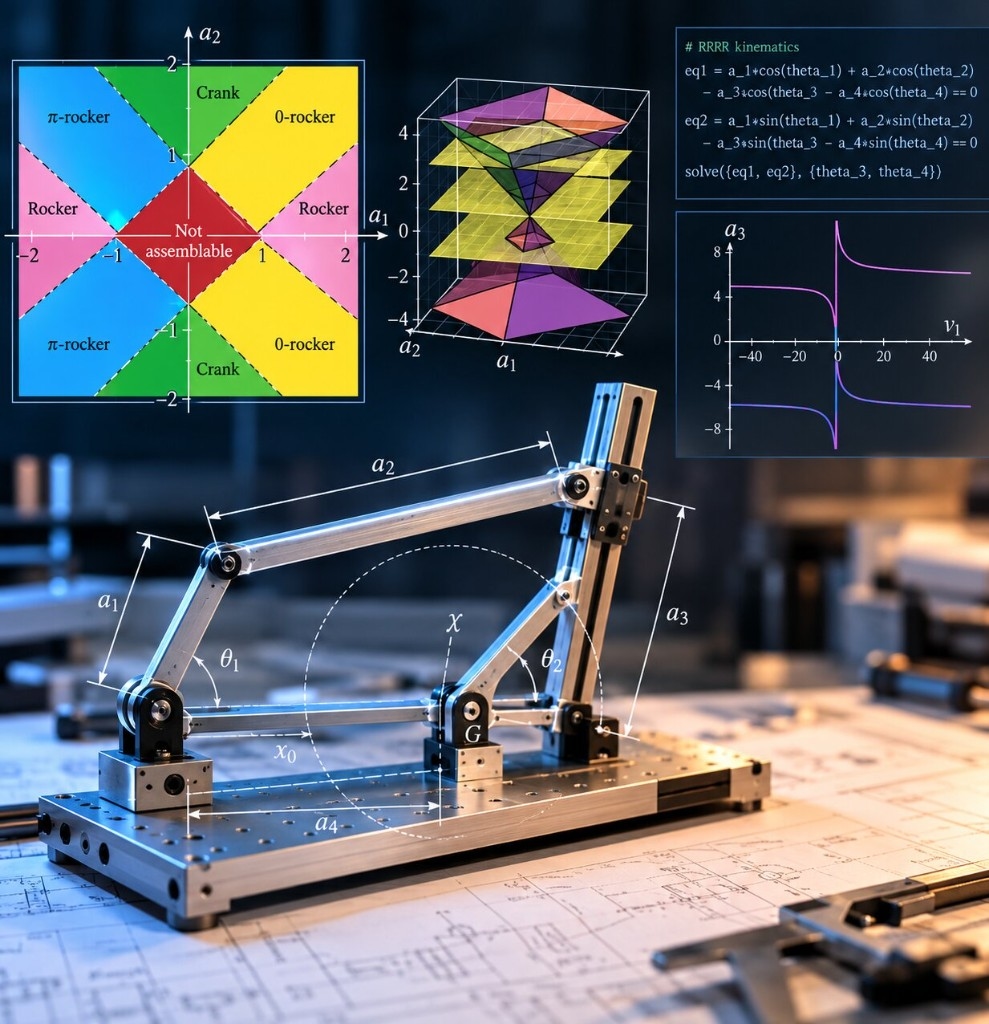
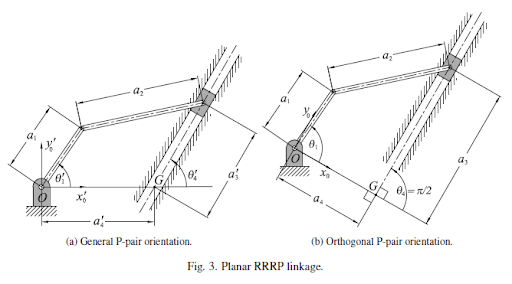
This project developed a fully algebraic method for predicting how a crank-slider mechanism will move based on its geometry. By replacing conventional, more complex trigonometric approaches with a simpler algebraic framework, we made it more efficient to predict a mechanism’s mobility directly from its link dimensions and slider position - before it is physically built.
WHY
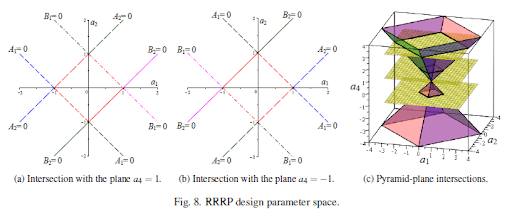
Linkage design can involve significant trial and error, as small changes in geometry can completely alter a mechanism’s motion. We developed an algebraic design map that links dimensions directly to mobility, making it easier to work backwards from a desired motion to a viable mechanism geometry.
HOW
I helped develop a fully algebraic model for RRRP crank-slider mechanisms, using Python, MATLAB, and Maple to relate input-link rotation and slider displacement directly to mechanism geometry. I identified critical motion limits and classified each design as a crank, rocker, π-rocker, or 0-rocker. These relationships were then mapped into a 3D design space, creating a simpler way for engineers to select linkage dimensions based on the motion they want to achieve.
Workflow: Mechanism geometry → Algebraic model → Motion limits → Mobility classification → Design map
For more details, see publications:
A. Nichol, M. Rotzoll, M.J.D. Hayes, June 3-4, 2021, “Planar RRRP Mechanism Design Parameter Space”, 11th CCToMM Symposium on Mechanisms, Machines, and Mechatronics, Ontario Tech University, Oshawa, ON, Canada.M.J.D. Hayes, M. Rotzoll, A.E. Iraei, A. Nichol, Q. Bucciol, December 6-10, 2021, “Algebraic Differential Kinematics of Planar 4R Linkages”, 20th International Conference on Advanced Robotics, ICAR 2021, Ljubljana, Slovenia.